Innovation and SOC: a great discussion during the webinar organised by the PROMETEO, Hy-SPIRE, 24/7 Zen and HyP3D projects
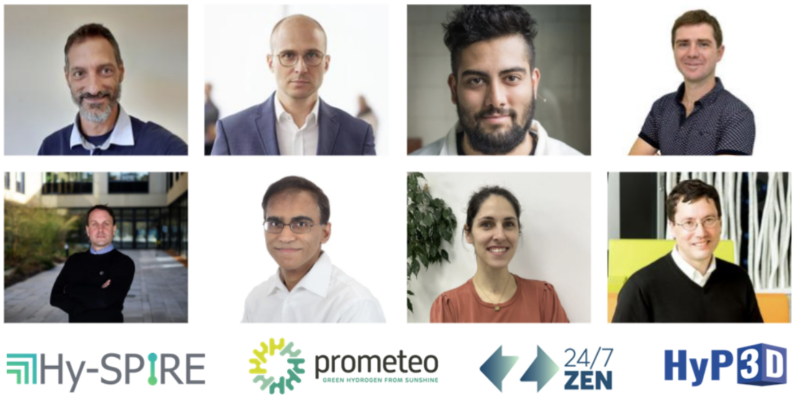
The PROMETEO and Hy-SPIRE Consortia organised a joint webinar on “Solid Oxide Cells: From Materials to Systems” on February 19, 2026, in strong collaboration with 24/7 Zen and HyP3D projects.
The webinar had a dual purpose: on one side, it aimed at presenting the results achieved so far by the projects, exchanging best practices and lessons learnt. On the other side, the projects wished to foster the discussion on the potential of SOCs, which have emerged as a cornerstone technology for high-efficiency energy conversion with great versatility. This is the reason why the event was structured to touch different aspects from materials innovation to the design of systems and industrial applications.
The webinar was successful and raised the interest of a high number of people. This is witnessed by the numbers: 260 people enrolled via Eventbrite in the webinar and almost 140 participated in the webinar.
Highlights:
- PROMETEO prototype is under construction and will soon be installed at ENEA Premises where it will be connected to a hydrogen valley
- Hy-SPIRE developed ultra-thin electrolytes for O-SOE and P-SOE cells through the optimization of nano-suspension coating processes, and a thin, fully dense barrier layers by optimising barrier-layer compositions and implementing PLD technology.
- 24/7 Zen achieved different goals and results from fundamentals to demo level and in particular the project developed new electrodes achieving 3A/cm2 at cell level and are proceeding with the installation of the final system in Greece
- HyP3D successfully fabricated large-area cells incorporating features designed for high-pressure operation, validated cells in SRU and 20-cells stacks at atmospheric pressure and the first SRU was successfully tested up to 2 bar
- DTU further improved by integration of an anode functional layer and successfully up-scaled cells which can be produced in batches of >20 cells.
- Within HYP3D, IREC build their own stack starting from 3-cell short stack and a 18-cell stack which was a first proof of concept of stacking these cells and testing them at atmospheric pressure, which allowed HyP3D to approach some power densities close to the one of conventional SOC technology
- EPFL developed a 3D model pf a Stack Repeating Unit with dynamic capabilities and run a wide test campaign
- Within 24/7 Zen, IREC underlined the importance of continuous operation as it is a durability and economic necessity for SOC systems, demonstrated that thermal cycling, standby losses, and repeated start-up transients significantly impact efficiency and degradation.
INFORMATION ON SPEAKERS
- Dr. Alberto Giaconia is a Researcher at ENEA where he currently covers the position of Head of Laboratory for Hydrogen and new Energy Vectors with about 50 scientists and technicians covering the whole value chain of hydrogen and renewable fuels. He coordinates PROMETEO Project.
- Prof. Jakub Kupecki at the Center for Hydrogen Technologies (CTH2) of IEN, took up the position of Director of the National Centre for Nuclear Research in September 2025. Member of the Executive Board of Hydrogen Europe Research, Coordinating Board in Polish Hydrogen Strategy and the Expert Group focused on Hydrogen in the Chamber of Natural Gas Industry, and Member of the Committee of Power Engineering of the Polish Academy of Sciences. Prof. Kupecki coordinates two Clean Hydrogen Partnership projects: HYSPARK and Hy-SPIRE Project.
- Dr. Antonio Gianfranco Sabato is Research Scientist at IREC. His career is dedicated to advanced ceramics for solid-state energy conversion and storage. Over the past five years, his research has focused on advanced processing of Solid Oxide Cell materials, combining additive manufacturing of YSZ electrolyte-supported cells with advanced and ultrafast high-temperature sintering methods.
- Dr. Marc Torrell Faro is a researcher in the Nanoionics and Fuel Cell Group at IREC, focusing on ceramic electrochemical devices for hydrogen production and use, including SOEC and SOFC technologies with advanced ceramic manufacturing. Dr. Torrell coordinates the 24_7 ZEN Project
- Prof. Wolff-Ragnar Kiebach – Professor at the DTU and Head of the Section for Applied Ceramics and Processing. One of his research focuses is on PCCs, spanning material development, processing, and characterization for electrochemical energy devices. A central objective of his work is the accelerated implementation of materials into prototypes, including the upscaling of PCCs for practical applications.
- Prof. Jan Van Herle – Since 2013, he has been the head of the Group of Energy Materials (GEM), a leading laboratory at EPFL for developing state-of-the-art fuel cells and electrolyzers.
- Dr. Mahal Patel – Technology Engineer Ammonia at Stamicarbon. He brings extensive experience in syngas technologies including methanation, CO-shift, and autothermal reforming. With deep expertise in process design, he plays a pivotal role in the Ammonia/Nitrates department, driving innovative solutions for ammonia and related technologies
- Dr. Lucile Bernadet is a research scientist at IREC, specialising in Solid Oxide Cells from materials to system-prototype scale. 20 peer-reviewed publications, 25 projects, +10 years of experience in the field give her a comprehensive understanding of the technology and its challenges.
- Dr. José González-Aguilar – physicist and Head of the High Temperature Processes Unit at IMDEA Energy, leading research on high-temperature energy conversion and storage for renewable hydrogen and solar fuels. His work on solid oxide electrolysis focused on their thermodynamic and system-level integration with concentrated solar thermal, advanced thermal energy storage, and industrial heat sources. He combines fundamental physics, system modeling, and techno-economic analysis to advance electrolysis-based pathways from laboratory concepts to pilot-scale demonstration.
- Dr. Kosova Kreka is a postdoc researcher at IREC.
- Dr. Anna Niemczyk – Eng. Assistant Professor at the Department of High-Temperature Electrochemical Processes at IEN since October 2020, and Acting Head of the Department from September 2025. She has 10+ years of experience in research on new materials for SOEC, oxygen membranes, and oxygen storage materials, as well as in the preparation of solid oxide cells and the characterization of their electrochemical and microstructural properties. She has been a project manager and investigator in several funded and commercial projects.
- Dr. Matteo Testi – Head of the Hydrogen Technologies and Resilient Energy System Unit at the Center for Sustainable Energy. He holds a PhD in Physics at the University of Trento on novel materials and methods for solid-state hydrogen storage technologies. He has expertise in numerical multiphysics and multiscale simulation tools, system control software, and chemical laboratory procedures, as well as developing control strategies for prototypes and physical systems. He is involved in different European projects.
ATTACHMENTS
Agenda: https://prometeo-project.eu/wp-content/uploads/2026/03/Workshop-program-2.pdf
Presentazioni:
- Projects pitches / introductions:
- A. Giaconia “PROMETEO Project“
- J. Kupecki “Hy-SPIRE Project“
- M. F. Torrell “24/7 Zen Project“
- A. G. Sabato “HYP3D Project“
- Session 1: Materials and technologies for new cells component
- W.-R. Kiebach “Upscaling of proton conducting ceramic cells“
- A. G. Sabato “Additive manufacturing of Yttria Stabilized Zirconia for Solid Oxide Cells“
- Session 2: SOEC: From the cell design to industrial application
- Session 3: How to guarantee uninterrupted operation of SOC systems
- L. Bernadet “Power-to-Gas-to-Power as a key solution for continuous SOC operation”
- J. González-Aguilar “Storage and operation modes to enhance SOFC durability & reliability”
RECORDING OF THE WEBINAR:
If you wish to watch the recording of the webinar, please click on the video below!
At the moment of the registration via Eventbrite, all participants declared to (i) have read and understood the policy about the processing of personal data, (ii) be aware that the public event may be recorded and that video/audio recordings and photographs may be disclosed on FBK and the projects’ institutional channels.